

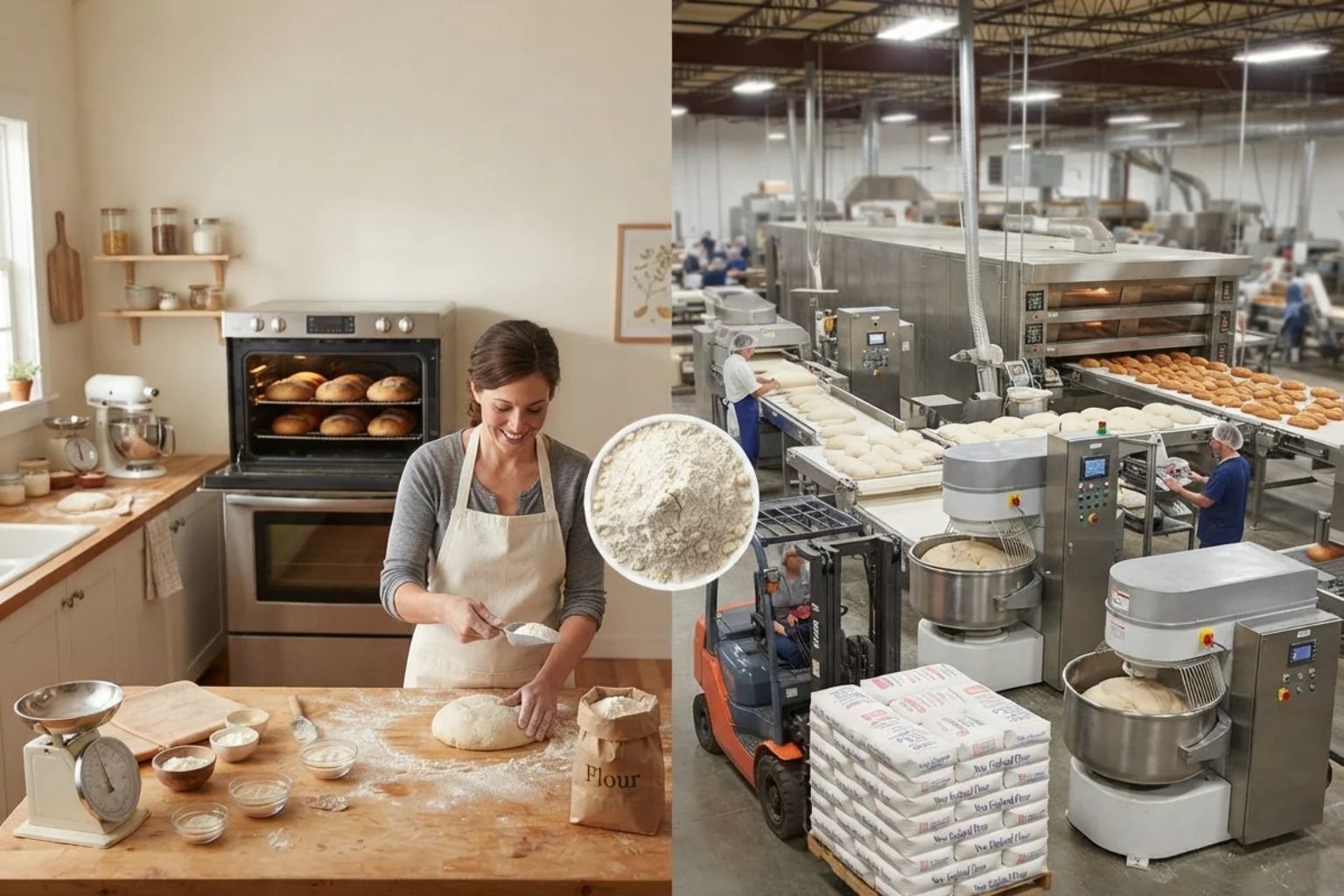
The food product produced in a domestic kitchen could attract buyers, make a mark at local stores, and secure repeat orders from small retail outlets. However, when there is increased demand and the process shifts to the commercial production setting, the same food product would encounter difficulties that were unknown before.
The textures could get affected, the taste could be inconsistent, the cost could go up, and the batches could not be as successful as before.
Scaling a food product is not just making more; it is making more without losing the quality and safety of the product.
1. Why Scaling Is More Complicated Than Increasing Quantities
It is not certain that the formula developed for a smaller batch would function in a similar manner when applied to a larger quantity because of the differences in the mixing procedure and equipment involved with the larger batch.
A baker producing dozens of loaves can have a small-sized mixer and an old-fashioned oven. Thousands of loaves require using different equipment – mixers, automatic portioners, proofing devices, and baking machines.
Therefore, multiplying quantities of all ingredients may not produce the desired result. It is necessary to test formulas during the real manufacturing process and establish standards for each step.
2. Maintaining Ingredient Consistency at Higher Volumes
A small variation in ingredients at the industrial level may result in impacting a few thousand products. Flour is an important factor to be considered when it comes to baking. Factors like protein content of flour, moisture percentage and absorption capability determine the dough formation, fermenting ability and texture of the baked product.
Two similar-looking flours may differ in behavior when mixed and baked. Thus, dependability of the supplier and specifications of ingredients are very important. Manufacturers should lay down the purchasing specifications and monitor certain quality parameters instead of assuming that all the deliveries would behave the same.
A dependable flour supplier is always helpful, but apart from that, the flour should meet the purpose for which it is intended.
3. Adapting Equipment and Production Processes
Small batch equipment does not operate like industrial equipment. Depending on the size of the mixer, mechanical energy will differ due to the variation in friction. Distribution of heat in commercial ovens will vary too. All these variations may end up affecting the moisture content, texture, color, and weight of the product.
To control the change, conduct some trial runs in the same way as in the full-scale production, taking notes of the important parameters – mixing time, dough temperature, proofing conditions, baking temperature, and weight of the end-product.
Written procedures are important as well. They enable operators to use the same recipe and rely less on subjective judgement.
4. Protecting Food Safety and Shelf Life
What may be a problem for one small batch can turn out to be a serious issue in the case of thousands of units produced. Contamination, allergen cross-contact, poor sanitation, mislabeling, and inappropriate storage need to be under control.
Manufacturers have to create appropriate processes for their products, such as hazard analysis, sanitation plans, temperature control, supplier validation, allergen control, and corrective actions documentation. There are preventive controls and HACCP principles of food safety management which include identification, control and monitoring of potential hazards.
It is important to pay the same attention to shelf-life management since moisture, packaging, processing and storage temperature may all impact the period during which the product remains fit for consumption.
5. Managing Costs, Waste, and Efficiency
Increased sales does not guarantee increased profits because increased machinery, labor, utilities, packing materials, storage space, and quality control measures will increase the costs of operations significantly.
Manufacturers should go further than considering only raw material costs in the determination of the cost per unit sold since they must consider the cost of losses incurred during production, labor cost, energy cost, cost of packing materials, and cost of delivery among others.
6. Building a Practical Scale-Up Strategy
Growth management is more convenient when conducted systematically:
- Record the formulation of the initial formula: Raw materials used in preparation, yield estimation and properties of the final product.
- Pilot tests: Conduct small-scale testing, observing changes in the behavior of raw materials and/or the production process.
- Process validation: Confirming that the equipment, process, food safety measures and packaging deliver expected results over a period of time.
- Commercial feasibility evaluation: Costs, labor, waste, distribution and demand.
- Monitoring and improvement: Regular monitoring of quality reports and performance indicators, making controlled improvements.
Quality control cannot be solely based on final product inspection. It can be monitored, batch record can be made and clear acceptance criteria can be set, which will help detect the problem at an earlier stage and increase repeatability.
Conclusion
Scaling up also requires the protection of the elements that originally attract the customer and creating the processes of producing them safely and profitably.
Selection of ingredients is one such foundation. High-quality and correctly specified flour, in adequate supply, could facilitate consistency as volumes increase. Together with process validation, quality control and prudent cost management, these will go some way to enable businesses to transition from small-scale potential to commercial success.
New England Flour knows how important high-quality ingredients are for baking and food manufacturing. As manufacturers look to the next phase of expansion, selecting the right flour for their needs would be an invaluable step on the road to consistent production.
