

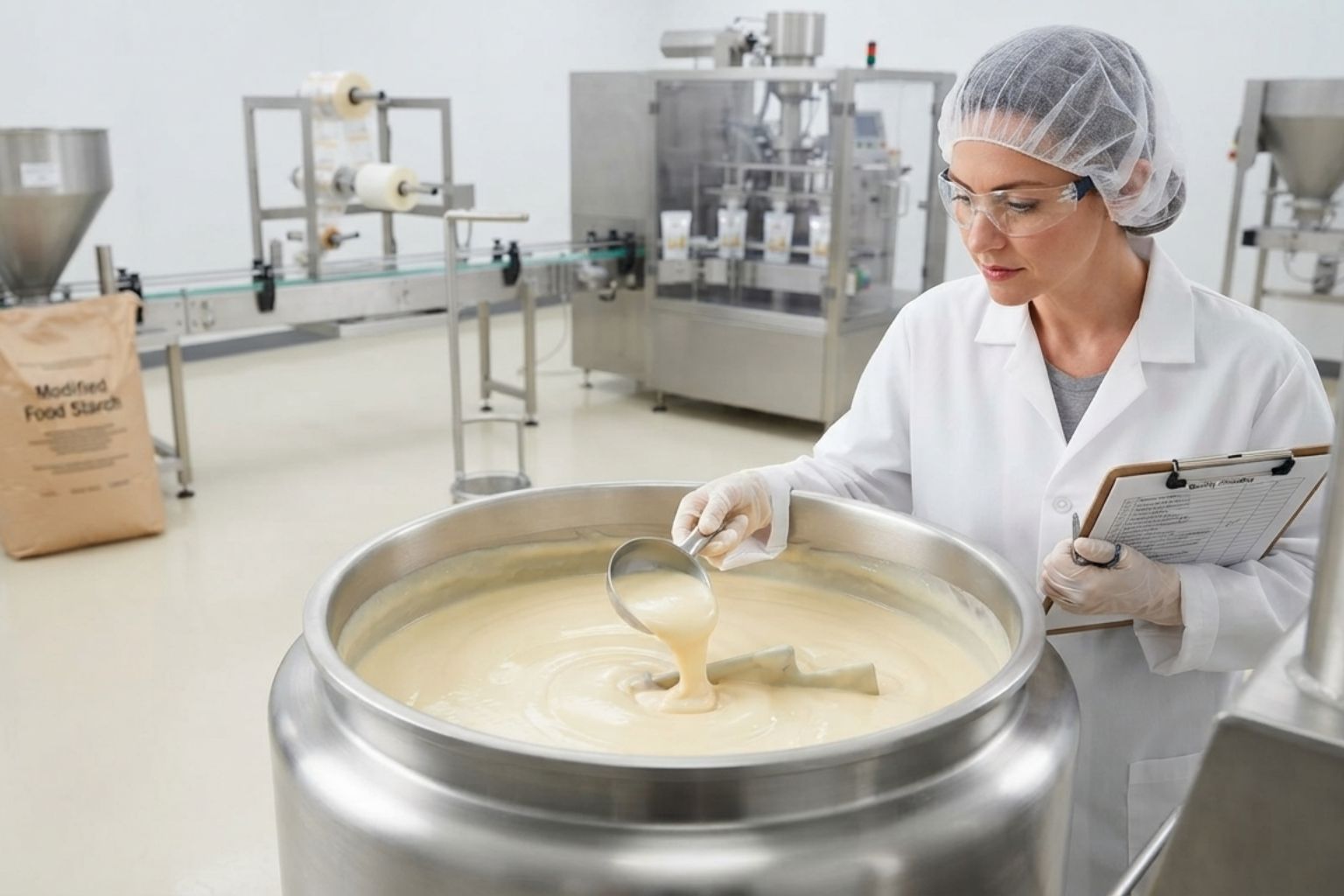
Stroll through a grocery store and you'll see products offering a surprisingly uniform texture, shelf life and product quality. Every consumer expects the same quality and consistency in each product he or she buys, ranging from creamy soups, sauces, and soft sandwich breads to dairy products and frozen meals. The secret to this consistency is one thing that is frequently overlooked: a starch.
Flour is used in so many foods, but starches are integral to the food manufacturing process. Knowing the role of starchy foods helps food producers enhance the quality of their products, save production time, and adapt to changing demands from consumers.
What Are Food Starches?
Starch is a natural carbohydrate found in many plants, including wheat, corn, potatoes, rice, and tapioca. It serves as an energy reserve for the plant, and it is one of the most versatile, easily available, and least expensive functional ingredients used in the food industry. However, starches can serve various functions in food processing other than bulk.
Starches might be able to:
- Thickener liquids
- Improve texture
- Stabilizer emulsions
- Binder
- Moisture retention
- Extend shelf life
- Improve freeze/thaw stability
Due to these functional properties, starches are critical to almost all segments of the food industry.
The Importance of Starches in Present-Day Manufacturing
Food manufacturers are under greater pressure to manufacture products that are consistent from batch to batch as well as to satisfy consumer demand for quality, convenience and value.
The role of starches is realized through the provision of:
- Efficient mass production
- High product consistency
- Enhanced process efficiency
- Increased storage stability of products
- Minimal ingredient segregation
- Better appearance and flavor
Starches play the part of active components influencing practically all production stages..
Native vs. Modified Starches
Most food manufacturers use one of two main types of starch.
Native Starches
Native starches are those starches which are extracted from plants and do not alter the structure of the starch. They work well in numerous conventional uses and under extremely tough processing conditions such as very high temperatures, acidic environment, freezing or prolonged mixing.
Sources of native starches are:
- Wheat
- Corn
- Potato
- Tapioca
- Rice
In some applications, native starches are often preferred because their formulations are simpler formulations.
Modified Starches
Modified starches are starches that have been processed in one or more ways to enhance certain desired functional properties. These changes help to ensure that starches stay resistant to harsh processing conditions, and that they retain their texture and stability. Importantly, 'modified' means not genetically modified but functional-processing modified.
The use of modified starches can provide:
- Better heat stability
- Better acid resistance
- Enhanced resistance to acid
- Enhanced freeze-thaw performance
- Less separation of water (or syneresis)
- Improved viscosity control
- Longer shelf-life stability
As a consequence of these properties, they have a number of applications in processed foods.
Key Functions of Starches in Food Production
1. Thickening
The most famous action of starch is to thicken.
During the heating process, the granules of starch absorb water and gelatinize, causing products to have the appropriate consistency, including:
- Soups
- Gravies
- Sauces
- Puddings
- Pie fillings
The right starch will produce smooth products without being too thick or too thin.
2. Texture Modification
Texture modification is one of the qualities that people search for.
Through starches, it is possible to formulate products which are:
- Soft
- Creamy
- Crunchy
- Chewy
- Lightweight
- Smooth
In making artisanal bread and ready to eat meals, starches play a key role in eating quality.
3. Moisture Preservation
Moisture preservation is crucial in prolonging the shelf life. In the process of production, the starches are able to retain moisture hence preventing drying and staling process of the products.
This applies especially to:
- Bread
- Cakes
- Muffins
- Tortillas
- Snacks products
Retention of moisture leads to improved shelf-life and reduces wastage of the product.
4. Processability
In the current era of food production, the production process is usually characterized by:
- High temperature
- Mechanical blending
- Acidic foods
- Refrigeration
- Freezing
- Reheating
Modified starches are produced to provide the required stability during these conditions.
Applications Across the Food Industry
Starches are used in many commercially prepared food products.
Bakery Products
Starches are used in breads, rolls, pastries and cakes for:
- Dough structure
- Moisture retention
- Soft crumb texture
- Improved volume
- Extended freshness
Starches, in combination with good quality flour, contribute to the uniformity of baking.
Sauces and Dressings
The starches used in sauces are used for:
- Smooth consistency
- Stable viscosity
- Resistance to separation
- Improved pourability
Conventional modified starches are especially valuable for foods that require storage, transport, and/or reheating.
Dairy Products
Starches are used in yoghurt, flavored milk, puddings and dairies desserts to help:
- Improve creaminess
- Prevent water separation
- Enhance mouthfeel
- Stabilize formulations
These characteristics are a great asset to a better final product.
Frozen Foods
The unique formulation problems with frozen food products are the potential for texture changes due to repeated freezing and thawing.
Specific starches are used to keep:
- Product consistency
- Sauce stability
- Moisture retention
- Appearance after reheating
This helps manufacturers to achieve consistent quality through the product's life cycle.
Meat and Plant-Based Products
Starches are extensively incorporated into processed meat and other alternatives to meat products to:
- Improve water retention
- Enhance texture
- Support binding
- Increase yield
- Improve slicing performance
These useful features assist manufacturers to improve quality and production efficiency.
Partnering with the Right Ingredient Supplier
Indispensable sourcing and technical knowledge are always needed for the most high-tech starch ingredient.
A supplier with experience in supplying ingredients will be able to help manufacturing companies:
- Identify the right starch for use in the application.
- Use raw materials that are consistently of high quality.
- Increase production efficiency
- Decrease formulation problems
- Supply sustainability
Having consistent ingredients will also make it easier to adapt to changing market demands.
Conclusion
There is no denying that starch is an important ingredient used in the present-day food industry that influences the food quality in terms of texture, water holding capacity, yield and stability. Using the right starch, the manufacturer will be able to produce foodstuffs of consistent quality that can be consumed by the customer without any hesitation.
At New England Flour, we understand how important it is for a food manufacturer to use only reliable ingredients and receive professional assistance. Apart from developing premium flour solutions, we cooperate with our customers to help them source quality solutions.
