

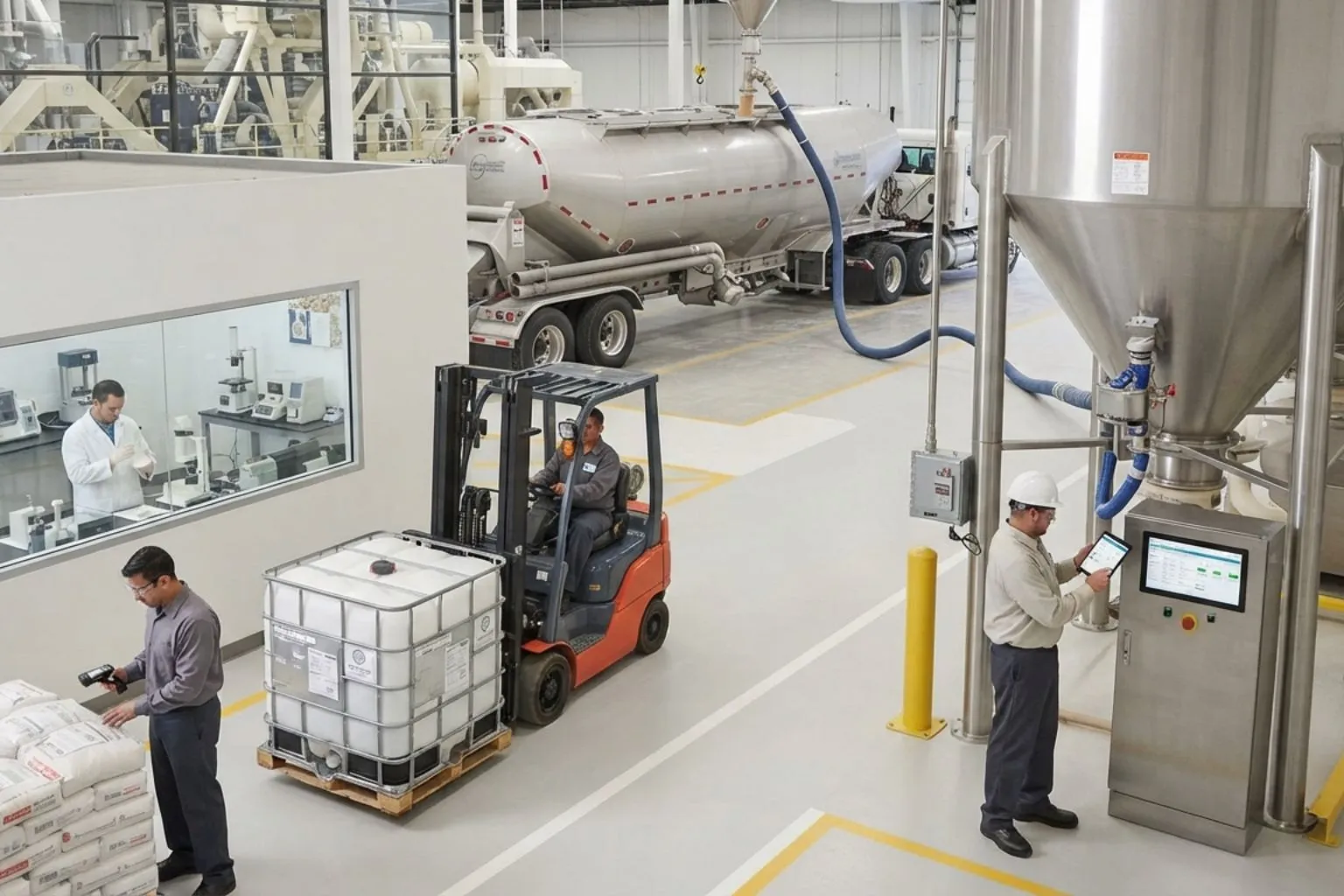
As production volumes increase, sourcing raw materials can become more complex for food manufacturers. A supplier that can manage smaller quantities may experience challenges when fulfilling larger orders, while changes in demand can also affect production planning and outcomes. A lower purchase price may not represent the best overall value when delays, waste, quality issues, and production disruptions are taken into account.
Thus, successful bulk sourcing cannot be limited to purchasing cheap bulk raw materials.
1. Define Ingredient Requirements Before Purchasing
In order to understand the requirement of having an effective sourcing strategy, one needs to understand the production process itself. When it comes to procuring flour or other bulk products, it is important for manufacturers to have a comprehensive specification with which they can evaluate various suppliers.
Depending on the ingredient and its intended application, specifications may include protein content, moisture, ash, particle size, extraction rate, wheat variety, and milling consistency.
It will also give an objective standard against which the purchasing and quality control teams can determine the value of the incoming shipments. For example, USDA procurement specifications provide various examples of how analytical, quality control and packaging requirements are incorporated into a procurement specification.
2. Evaluate Suppliers Beyond Price
While price is not an indicator of the value offered by the supplier, it is significant. In case the deliveries of the supplier are unreliable and/or the materials are inconsistent in quality from batch to batch, the low price per unit will turn out to be expensive.
When evaluating suppliers, manufacturers should consider whether they can provide:
- Products that consistently meet required specifications
- Sufficient production and supply capacity
- Reliable delivery performance
- Appropriate documentation and traceability
- Effective food safety and quality systems
- A clear process for responding to quality issues
Supplier performance needs to be audited on a regular basis and not only in the initial selection process. A supplier who constantly lives up to their specifications and delivery commitments offers much more value than the lowest-cost supplier.
3. Prioritise Food Safety and Supplier Verification
Food safety responsibilities do not end when bulk ingredients arrive at the manufacturer's receiving dock. Manufacturers should understand how their suppliers identify and control potential food safety risks and maintain appropriate traceability throughout the supply chain.
Verification from the supplier may include looking at the records of food safety, auditing, sampling and testing, and also looking at the history of the supplier and any corrective actions as per the ingredient involved.
Some of the key components in FDA guidance for FSMA compliance include verifying the supplier if the ingredient has a hazard that requires controls within the supply chain, and evaluating the supply chain risk for such ingredients.
4. Compare Total Cost, Not Just Unit Price
The price quoted per pound/tonne is just part of the buying equation. The better way to go is to work out the cost of the ingredient when purchased and used.
Consider:
- Purchase price
- Any charges for freight and delivery
- Storage requirements
- Handling costs
- Packaging
- Product losses
- Quality-related waste
- Production downtime
- Inventory carrying costs
The goal should thus be to make the purchasing process cost-efficient, not just as cheap as possible.
5. Choose the Right Bulk Delivery Format
The most appropriate mode of delivery will be determined by the amount of production and the design of the facility. This includes common bagged goods, bulk delivery and storage, totes, pneumatic tankers and silos.
High production volume may favor the use of bulk delivery and automation as a result of reducing handling activities and waste from packaging. The cost of doing this is only justified when the volume of production and the facility supports it.
Apart from space available, unloading facilities, employee handling needs, sanitization, and stock rotation, other requirements of the manufacturer should be considered.
6. Build Inventory Around Demand
While bulk purchasing can reduce the frequency of orders, poor inventory planning can create challenges such as excess stock, increased storage costs, or stockouts when demand changes unexpectedly.
Ingredient storage, such as flour, requires proper conditions for storage and if you have extra stock stored beyond your required amounts, then you incur additional costs and risk of spoilage due to moisture, pests, and contamination.
The following factors must be considered when formulating your stock:
- Production estimates
- Demand
- Supplier’s delivery time
- Minimum stock requirements
- Stock level – minimum and maximum.
- Lot control
- IFO control
The objective of having enough raw materials for production but without tying down money on materials that are going to lie idle for too long.
7. Establish Contingency Plans
While even good suppliers might still have transport problems or other unforeseen circumstances, manufacturers should always think about having continuity of supply during the sourcing process.
In case of important ingredients, companies may look at other suppliers, acceptable alternative specifications, and extra safety stock. However, the alternatives must be qualified in advance in case of an emergency; otherwise, the change of ingredient will affect processing efficiency or product properties without prior testing.
A contingency plan will help to act faster in case of any changes in the supply situation.
Develop a Sourcing Strategy for the Long-Term
An effective bulk ingredient sourcing strategy should bring together procurement, production, quality control, logistics, and financial considerations. The question should not simply be, "Who offers the lowest price?" but rather, "Which sourcing strategy provides reliable supply, consistent performance, and long-term value?"
For food manufacturers, solutions to these questions may be answered through proper specification, trustworthy suppliers, verification, appropriate inventory control, and dependable logistics.
New England Flour understands that bulk ingredient sourcing is about more than purchasing flour at a competitive price. It also involves supporting consistent quality, efficient logistics, and dependable production. By working with the right sourcing partners and developing a well-planned procurement strategy, food manufacturers can make more informed purchasing decisions and build a more reliable supply chain for the future.
